

Hello, I’m Sharon
I taught Indonesian and French for more than 20 years in Primary and Secondary schools in Adelaide and Melbourne, Australia. I have many years experience devising and implementing primary and secondary Indonesian programs, as well as being Head of Languages in a large secondary school in Melbourne.



-
Just what is in the Indonesian Sentence Builder book?

The book contains 19 macro-units which concern themselves with specific communicative functions such as ‘Describing people’s appearance and personality’, ‘Comparing and contrasting people’, ‘Saying what you like and dislike’ or ‘Saying what you and others do in your free time.’
Each unit includes:
- a sentence builder modelling the target constructions;
- a set of vocabulary building activities which reinforce the material in the sentence builder;
- a set of narrow reading texts exploited through a range of tasks focusing on both the meaning and structural levels of the text;
- a set of translation tasks aimed at consolidation through retrieval practice;
- a set of writing tasks targeting essential writing micro-skills such as spelling, functional and positional processing, editing and communication of meaning.
In addition to the macro units, there are micro units to help you to implement lots of systematic recycling and interleaving, two techniques that allow for stronger retention and transfer of learning. These micro units include units on grammar, question-skills, revision quickies, and self-tests. The self-tests are divided into two sections, one for less confident and one for more confident learners.
Unit Titles
Unit 1: Talking about my age
Unit 2: Saying when my birthday is
Unit 3: Describing hair and eyes
Unit 4: Saying where I live and am from
Unit 5: Talking about my family members, saying their age and how well I
get along with them
Unit 6: Part 1 Describing myself and another family member
Part 2 Describing my family and saying why I like/dislike them
Unit 7: Talking about pets
Unit 8: Saying what jobs people do, why they like/dislike them and where
they work
Unit 9: Comparing appearance and personality
Unit 10: Saying what’s in my school bag/classroom/describing colour.
Unit 11: Talking about food likes & dislikes – Part 1 Reasons; Part 2
Mealtimes
Unit 12: Talking about food likes & dislikes – Part 2 Mealtimes
Unit 13: Talking about clothes and accessories I wear how frequently and
when
Unit 14: Saying what I and others do in our free time
Unit 15: Talking about the weather and free time
Unit 16: Talking about my daily routine
Unit 17: Describing my house – location and what I like/dislike about it
Unit 18: Saying what I do at home, how often, when and where
Unit 19: Talking about future plans for holidays
For those of you who use https://www.sentencebuilders.com, resources from the sentence builders in each unit of the Indonesian Sentence Builder book have been uploaded to the Sentence Builder website.
The book is available to order from Language International Bookshop (Intext), Amazon Australia, and Book Depository.
Upcoming post: Using the Indonesian Sentence Builders book in the classroom
-
Purchase on Amazon!
Indonesian Sentence Builders is a brand new workbook aimed at beginner to pre-intermediate students.
This ‘no-frills’ book contains 19 units of work on very popular themes, jam-packed with graded vocabulary-building, reading, translation, retrieval practice and writing activities. Key vocabulary, lexical patterns and structures are recycled and interleaved throughout.
Each unit includes:
1) A sentence builder modelling the target constructions;
2) A set of vocabulary building activities;
3) A set of narrow reading texts exploited through a range of tasks focusing on both the meaning and structural levels of the text;
4) A set of retrieval-practice translation tasks;
5) A set of writing tasks targeting essential micro-skills such as spelling, lexical retrieval, syntax, editing and communication of meaning.
Based on the Extensive Processing Instruction (E.P.I.) principle that learners learn best from comprehensible and highly patterned input flooded with the target linguistic features, the authors have carefully designed each and every text and activity to enable the student to process and produce each item many times over.
This occurs throughout each unit of work as well as in smaller grammar, vocabulary and question-skills micro-units located at regular intervals in the book, which aim at reinforcing the understanding and retention of the target grammar, vocabulary and question patterns.This is from the Amazon description! This book is available now on Amazon.
Purchase today

-
New Secondary Indonesian curriculum for 7-9
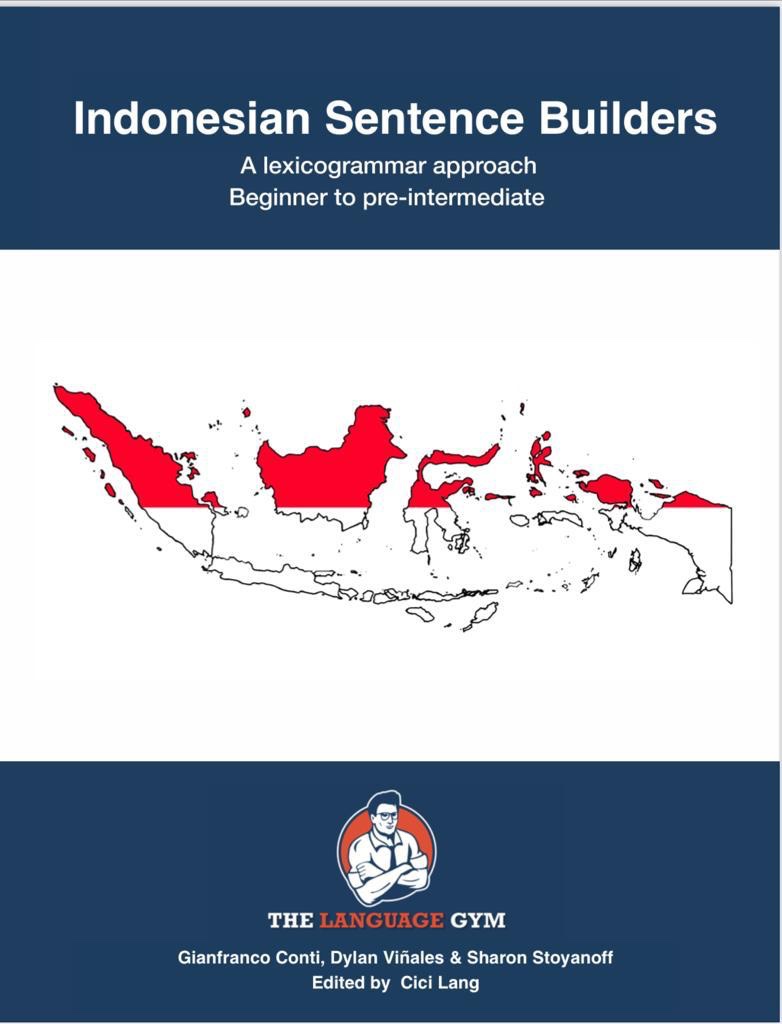
Are you starting to plan your Indonesian curriculum for 2023?
I am excited to announce that a brand-new resource for secondary teachers of Indonesian is about to hit the shelves. At the time of writing, the Indonesian Sentence Builder; A lexicogrammar approach for Beginners to Pre-Intermediate book is being printed. I am pleased to have had the opportunity to co-author the book with Gianfranco Conti and Dylan Viñales, with the expertise of Ibu Cici Lang to reference as our editor.
The Sentence Builder book provides a comprehensive framework upon which to build your Indonesian Language Program and has been developed to reflect the Australian Curriculum. The 19 units in the book are suitable for use to develop a three year program for students in Year 7 to Year 9. Interspersed within the units are 16 Grammar Time sentence builders and related exercises. There are also Revision Quickie and Question Skills sections. Each unit has an associated Vocabulary Test which has two levels.
The Indonesian Sentence Builder book is perfect to use with the SentenceBuilder.com website. The material from the sentence builders contained in the book are being uploaded to the Sentence Builder website enabling your students to interact further with the material from the book.
Pre-order your copy of Indonesian Sentence Builders at the Intext Book Company website https://www.languageint.com.au/search/Sentence%20Builder/
To be a global citizen in these times is challenging and we should be prepared to engage with and be curious about those around us. As teachers of languages, we encourage our students to connect with not only the language they are learning, but also the people and culture which intertwines through it. Participation in learning languages strengthens connections between people and leads to understanding, tolerance and respect for differences.
About Me
Sharon Stoyanoff taught for more than 20 years in Primary and Secondary schools in Adelaide and Melbourne, Australia. She has experience devising and implementing primary and secondary Indonesian programs, and was Head of Languages for the final years of her Secondary teaching career.
Follow Me On
Subscribe To My Newsletter
Subscribe for updates
 Ibu Sharon